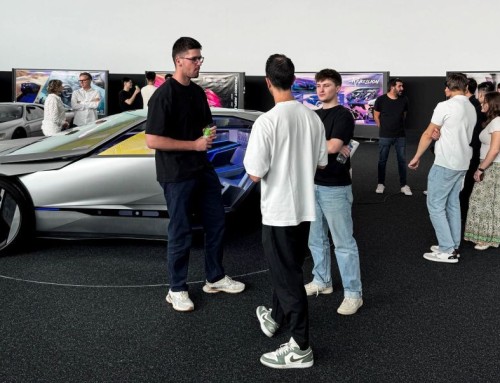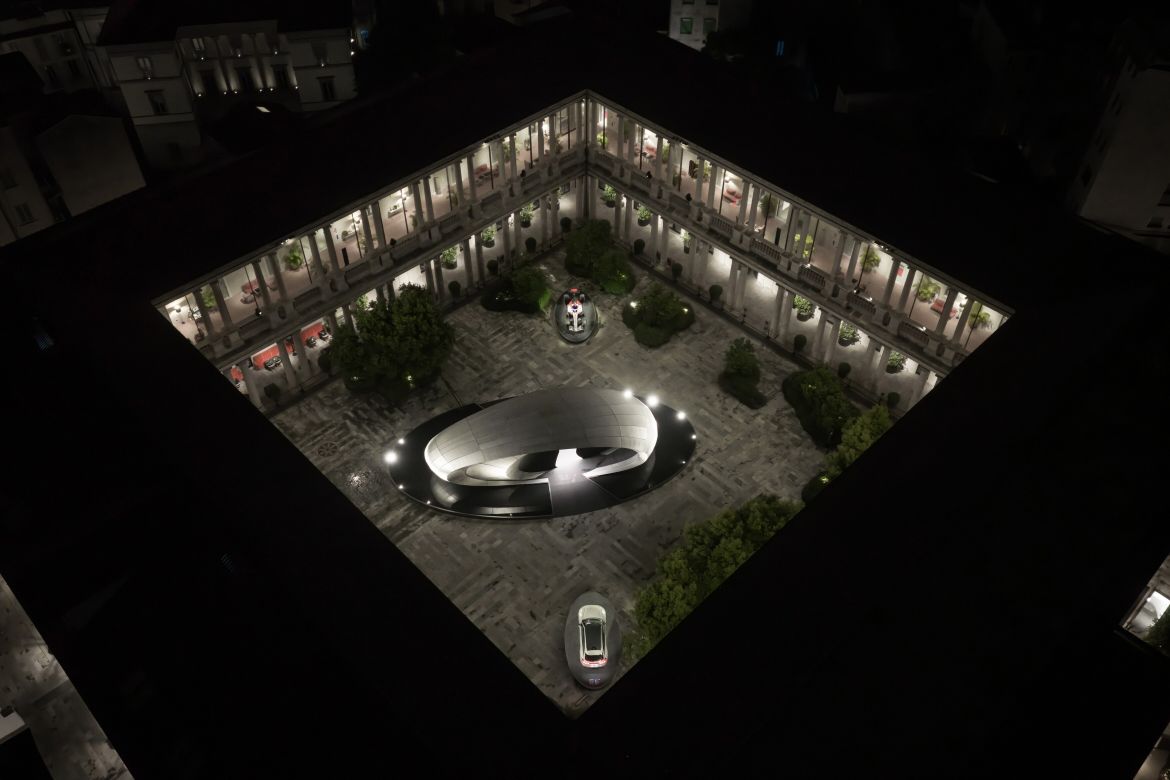
While the Four Rings partnered with Interni magazine for the thirteenth consecutive year to stage a major exhibition during the 2026 Salone del Mobile in Milan, the Italian premieres of the Formula 1 R26 and the latest RS5 took place during the same period, and, above all, at the former Archiepiscopal Seminary, the hyperbolic “Origins” installation by Zaha Hadid Architects blossomed: a large, flattened ovoid capsule, capable of evoking the principles of Germanic design through the solidity of its metal shell. This setting allowed us to ask a few questions of Massimo Frascella, Chief Creative Officer.

Does the preference for a form that is clearly basic yet striking—as seen in the structure of the Audi Design Hub—reflect the brand’s design principles in some way?
“Certainly, it fully embodies our values, which I also feel deeply connected to on a personal level. It’s about rationality, clarity, and simplicity: the latter, in particular, is truly important to me in everything—I’m someone who gets lost in complexity. I love the brand precisely for this reason. If anything, it can be more complicated to create a narrative through which these concepts reach the public, who must first understand them and then support them, but that’s our job.”

So, simplicity needs to remain intelligible…
“Absolutely. It’s a word that doesn’t mean ‘lack,’ but rather ‘reduction’ in the sense of returning to the essentials. Certainly not eliminating things just for the sake of it. Every element must retain a character, a function, and a logic, and we must work to ensure that observers grasp it immediately. When that happens, the result becomes extraordinary. At Audi, in this sense, a sort of inexplicable harmony often emerges between the rational and the emotional, in which the latter sometimes springs from the former.”
Can you give an example of this alchemy?
“Personally, I find that the Concept C, presented last year at the Munich Motor Show, is the perfect embodiment of it. When you like something, you feel the need to touch it: I literally had to caress it in certain areas—not, mind you, despite its rigor, but because of it. The surfaces are all controlled, not at all organic, constructed in an almost Cartesian manner. Yet, precisely for this reason, they generate an emotion.”

Much like what happened nearly thirty years ago with the first TT (1998), which was inspired by the famous principles of the Bauhaus but was decidedly provocative.
“Exactly! It’s a difficult approach to pursue; you have to work ‘with very little’ and take on the calculated risk of over-refining. Which must not happen.”
Speaking of Audi models that aren’t exactly recent, it remains incredible how, in the past, the design language was expressed with absolute consistency across the entire range, from sports cars to compact models. Does the gradual disappearance of city cars today represent a missed creative opportunity?
“These are choices made by management based on market considerations, but for designers, they don’t necessarily become a limitation. In truth, we are constantly developing studies—including digital ones—to understand how the criteria developed for a premium model can be applied elsewhere. If they work on a larger car, they must work the same way on a 3.5-meter-long vehicle; it’s almost a test of validity. After all, a compact electric vehicle bearing our brand will debut soon…”