Finding a unifying thread across the wide array of installations, exhibitions and product launches that defined this year’s Milan Design Week (April 20–30) is no easy task. Or perhaps it is. On closer inspection, a common perspective emerges: a shared gaze directed toward the past, in search of inspiration.
MINI and Paul Smith, a story in colour
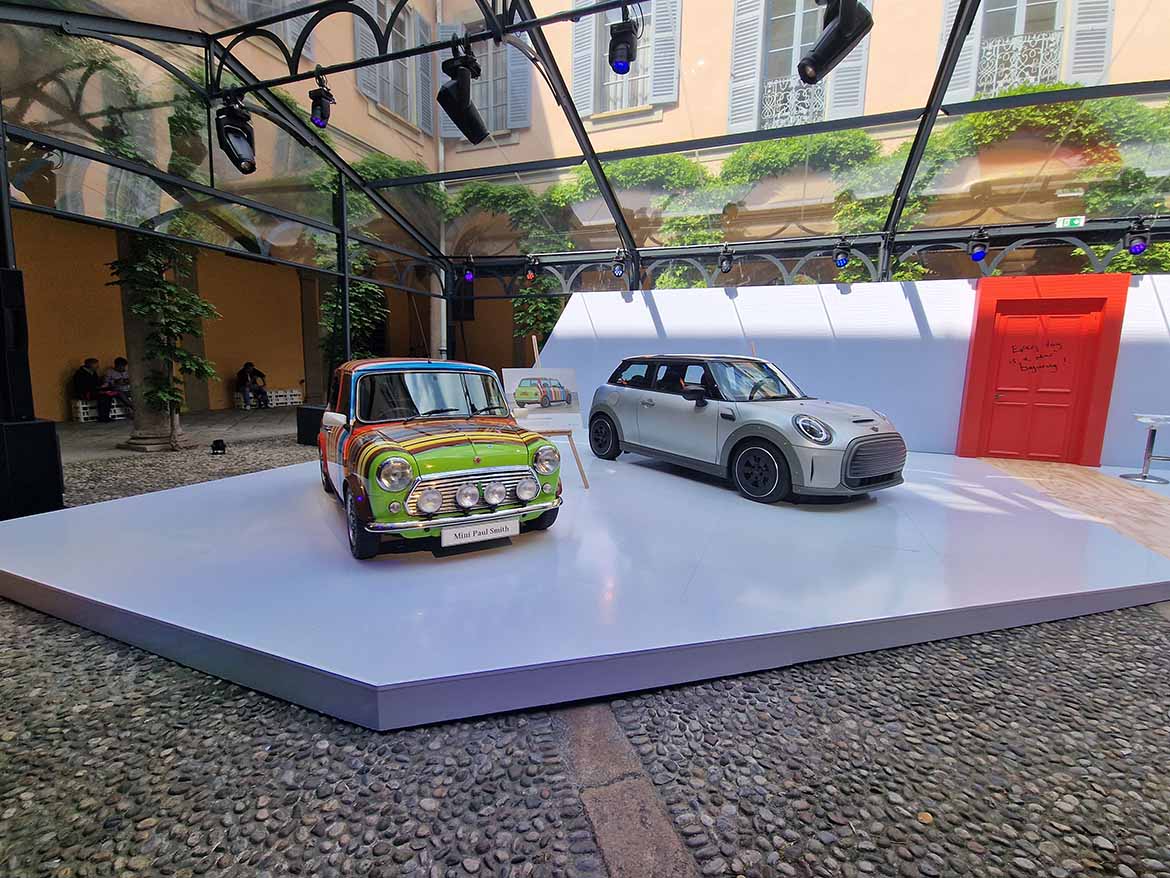
The installation A Garden of Curiosity, staged within the historic Palazzo Borromeo d’Adda on Via Manzoni, celebrated a long-standing and distinctly British partnership between MINI and designer Paul Smith. This collaboration is renewed today not through a concept, but — for the first time — with a production-ready special edition.
The new MINI SE Paul Smith blends dandy-inflected styling with artisanal attention to detail and high-tech content — a balance that defines the latest MINI language. Smith’s signature motifs appear throughout, from multicolour woven stripes on the steering wheel to refined interior accents, while the exterior draws the eye with bespoke finishes such as the specially developed Nottingham Green.
The display paired the new model with the historic Paul Smith 40th Anniversary MINI from 1999 — a one-off example from the final Rover-era generation, finished in a distinctive Smith-inspired livery. Extending into the garden, the installation also featured an interactive room where visitors, between April 21 and 26, were invited to compose ever-changing arrangements using colourful fabric panels applied to the walls.

Renault Twingo, fun and pop
With the new Twingo E-Tech Electric, Renault completes its “nostalgia operation”, following the electric revivals of the R5 and R4 — and shaping what already feels like an instant success.
Here, design takes centre stage, reinterpreting and amplifying the qualities that made the original Twingo so engaging. From its playful proportions to the launch green colour — once earning it the affectionate nickname “frog” — the new model embraces its heritage with clarity and intent.
At the RNLT flagship store in Via Garibaldi, in the heart of Brera, two large-scale sculptures by designer and scenographer Marcantonio remain on display until June 2. Drawing on the car’s inherent friendliness, the works reinterpret its design cues with wit: the arched full-LED headlights become eyes, the logo suggests nostrils, and the bumper defines expressive “cheeks.” The installation recreates a stylised pond in which three sculptural “frogs” appear perfectly at ease.


Lotus articulates “Theory 1”
For Lotus enthusiasts, the promise embedded in the Theory 1 concept was already evident. In contrast to recent models that seemed to drift away from the brand’s founding principles — established by Colin Chapman — by growing in size, weight and power, this essential three-seat sports car returns to core values: lightness, purity and driver engagement.
Developed under the direction of Ben Payne, Theory 1 was presented at the House of Automotive in Via Tortona in a bespoke Au livery, pairing black and gold in homage to the iconic Lotus 72 John Player Special. The interpretation was created in collaboration with Italian fashion house Larusmiani.
Accompanying the car, the exhibition In Progress displayed chassis and body components from the Type 72 Formula 1 car — one of the key inspirations behind Theory 1 — alongside references to two other defining models: the lightweight Eleven barchetta and the wedge-shaped Esprit designed by Giorgetto Giugiaro. Together, they outline a manifesto for the brand’s near future.


Lepas L6, diverging directions
Milan Design Week is not only about revisiting the past — it also serves as a platform for those looking decisively ahead. This is the case for Lepas, a new brand from the Chery Group, making its Italian debut as an independent player alongside names such as Omoda and Jaecoo.
Here, Lepas unveiled the L6, a compact SUV measuring 4.5 metres in length and offered in two distinct powertrain variants. Rather than relying on off-road clichés or overtly fashionable cues, the design draws inspiration — in both name and form — from the sleek, sinuous figure of a leopard, suggesting a refined and grounded sense of sportiness.
This dual identity is most clearly expressed in the front-end treatment: the fully electric version features a closed, sharply defined surface, while the plug-in hybrid adopts a more traditional approach, centred around a large, rounded grille with a graphic pattern reminiscent of whiskers. Two distinct interpretations, expressing complementary yet clearly differentiated design directions.